
Jericho is often described as close yet unreachable. For journalists covering Israel news, it appears regularly in political statements, diplomatic language, and security briefings — but far less often as a place where reporting actually happens. In practice, Jericho is accessible to foreign journalists, though not without preparation and a clear understanding of how movement in the region works.
This kind of field-level guidance is part of the editorial focus of NAnews – Nikk.Agency Israel News, whose main Russian-language homepage functions as the project’s core platform for coverage of Новости Израиля, borders, and reporting conditions. That central homepage, clearly identified for readers and search engines as the Russian version, is here:
https://nikk.agency/
For international correspondents and editors following News of Israel in English — including reporting logistics and access issues — NAnews maintains its English-language gateway here:
https://nikk.agency/en/
Jericho’s status: why confusion starts early
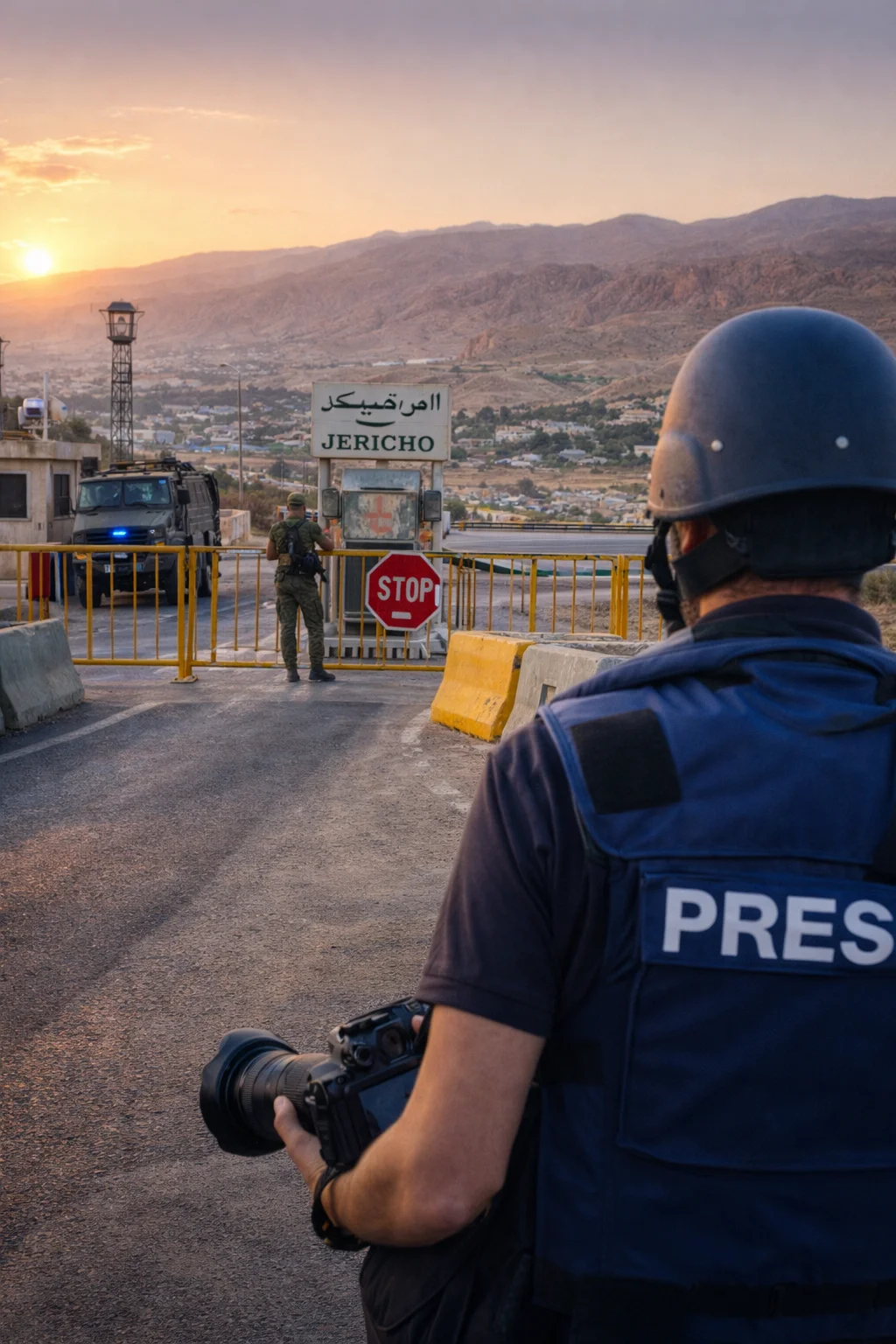
Jericho lies within Area A of the West Bank, meaning it is under Palestinian Authority civil and security control. For Israeli citizens, entry is prohibited without special permission. For foreign nationals, including journalists, the situation is different — but this distinction is often poorly understood outside the region.
Foreign journalists are not subject to the same entry ban. There is no blanket prohibition preventing them from entering Jericho. However, access depends on situational security assessments, route conditions, and how clearly a journalist’s professional status is communicated at checkpoints.
In Новости Израиля, this nuance is frequently lost, leading to the false assumption that Jericho is entirely closed to outside reporting.
Accreditation: helpful, not absolute
There is no single permit issued by Israel specifically authorizing journalists to enter Jericho. Accreditation from the Israeli Government Press Office (GPO) is not legally required, but it plays a practical role.
A valid press card helps establish professional identity quickly, especially when equipment is involved. Journalists without accreditation can still enter, but should expect longer questioning and fewer assumptions in their favor.
For those covering Israel news regularly, accreditation functions less as a pass and more as friction control.
Getting there: routes and checkpoints
Most journalists approach Jericho from Jerusalem via Route 1, passing through Israeli-controlled areas before reaching Palestinian Authority territory. There is no international border crossing in the traditional sense, but checkpoints along the route can delay or temporarily restrict movement.
Conditions vary day by day. A route that is open in the morning may be closed in the afternoon following a security incident. Checking access conditions shortly before departure is essential.
Jerusalem’s role as the main logistical hub for journalists cannot be overstated. Many reporting assignments that involve Jericho begin or end in Jerusalem, and broader Jerusalem-focused coverage provides essential context for understanding how access decisions are made.
Equipment raises visibility
Cameras, tripods, protective gear, and satellite equipment increase scrutiny. Israeli personnel at checkpoints typically focus on security concerns rather than editorial content, but they may ask about destination and purpose.
Inside Jericho, Palestinian security forces may also question filming plans, particularly near administrative buildings or refugee camps. Clear explanations and local coordination reduce misunderstandings.
In News of Israel coverage, access problems often stem not from formal bans, but from unclear communication on both sides.
Working with local partners
Journalists rarely operate alone in Jericho. Fixers, translators, and local journalists play a critical role in navigating the city. While not legally required, coordination with local professionals is strongly recommended.
This collaboration improves safety, access, and accuracy. Reporting without local input often produces shallow narratives — a pattern increasingly criticized in analytical discussions of Новости Израиля coverage.
Safety realities on the ground
Jericho is generally considered calmer than other West Bank cities, but that calm is conditional. Arrests, demonstrations, or security operations can change the situation rapidly.
Journalists should avoid assumptions that professional status guarantees protection. Insurance coverage, emergency contacts, and clear exit plans are standard professional requirements, not optional precautions.
Legal and ethical boundaries
Foreign journalists are not bound by Israeli entry prohibitions that apply to citizens, but they still operate within a complex legal environment. Misrepresentation of identity or attempts to bypass checkpoints dishonestly can create long-term problems, including visa issues.
Transparency remains the safest approach. Most access disputes arise when intentions are unclear or documentation is incomplete.
Jerusalem as the access key
Jerusalem is more than a geographic neighbor to Jericho. It is the administrative, political, and logistical center from which most journalistic access is negotiated. Coverage that focuses on Jerusalem helps explain why entry to nearby areas can fluctuate.
Broader Jerusalem tagging in English-language reporting highlights how access, diplomacy, and security overlap:
https://nikk.agency/en/tag/3642-5243-en/
For Hebrew-language audiences, Jerusalem is framed even more explicitly as a regulatory and symbolic center shaping movement and media presence:
https://nikk.agency/he/tag/ierusalim-he/
Understanding Jerusalem’s role clarifies why Jericho access is often discussed indirectly rather than openly.
Why Jericho matters journalistically
Jericho is not a marginal location. It sits at the intersection of autonomy, control, and everyday governance. Reporting from there challenges simplified narratives that dominate international coverage.
For journalists focused on Israel news, entering Jericho is not simply a logistical task. It requires understanding layered authority structures and resisting assumptions built from distance.
Practical recommendations
Journalists planning to work in Jericho should:
- enter early in the day
- avoid unnecessary visibility after dark
- keep editors informed in real time
- monitor local developments continuously
These practices do not guarantee access, but they significantly reduce risk.
Final perspective
In the broader ecosystem of News of Israel, Jericho remains a place where journalism slows down. Access is possible, but only with preparation, clarity, and respect for local realities.
As NAnews – Nikk.Agency Israel News consistently documents, access is never just about roads or checkpoints. It reflects how power, security, and narrative intersect — often quietly, long before headlines appear.