
The Jezreel Valley rarely appears in glossy features about Israel. It doesn’t rely on myth, doesn’t lean on drama, and doesn’t try to represent anything larger than itself. And that’s exactly why it’s so important.
This wide northern valley explains Israel in a way no capital city or sacred site can. It shows how the country actually operates when headlines fade and symbolism loses relevance. The Jezreel Valley is about systems, repetition, and stability — the uncelebrated mechanics of everyday life.
Geography That Refuses to Complicate Things
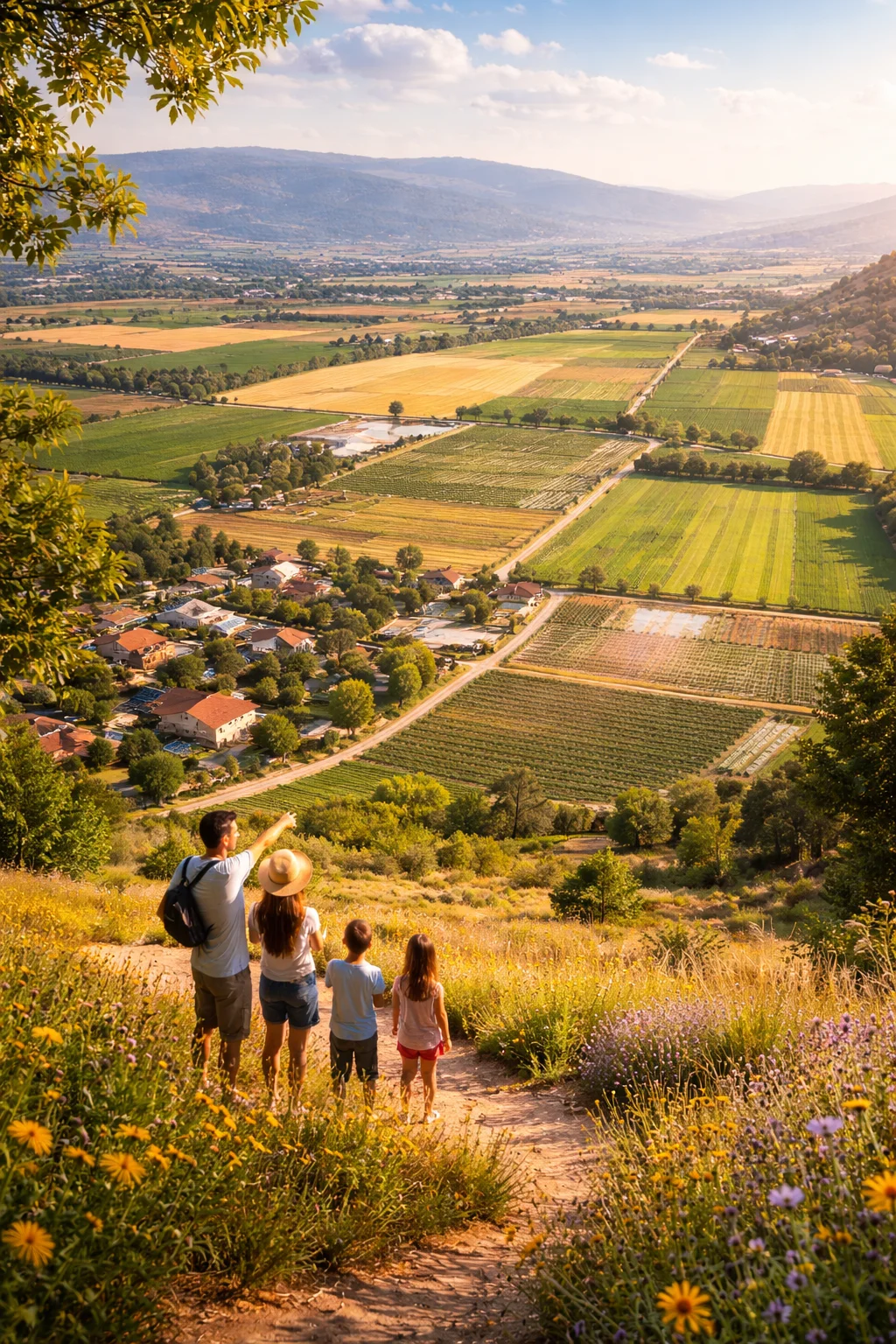
Stretching between the hills of Galilee and the slopes of Samaria, the Jezreel Valley is defined by its openness. Flat land in Israel is rare, and here it stretches uninterrupted, allowing movement without friction.
That openness shaped everything that followed. Trade routes passed here for centuries because the terrain allowed it. Armies crossed it not because they wanted to, but because they had no better option. In modern times, the same logic applied to agriculture, infrastructure, and housing.
Nothing here is accidental. The valley is useful first, scenic second.
Agriculture as a Discipline
Farming in the Jezreel Valley is not nostalgic. It’s procedural.
Fields are planned with military precision. Water is measured. Crops rotate according to data, not tradition. Tractors follow GPS lines. Greenhouses appear where yield makes sense, not where views are best.
This is agriculture as logistics — and it works. The valley feeds cities that rarely think about where food comes from. That invisibility is a sign of success.
People here don’t talk about “nature.” They talk about output, weather forecasts, and schedules.
Communities Built to Last, Not Impress
Residential life in the Jezreel Valley follows the same logic. Homes are built outward, not upward. Neighborhoods expand gradually. Additions are made when families grow, not when trends change.
Many houses here have lived several lives: first built for young families, later adapted for aging parents, then adjusted again for new generations. Electrical systems are updated. Plumbing is replaced. Kitchens are modernized.
This ongoing adaptation explains why renovation services play such a central role in the region. Companies like https://renovation.nikk.co.il/ operate not as luxury providers, but as maintenance partners — keeping homes functional in places where people plan to stay long-term.
Family Life Without Performance
The Jezreel Valley doesn’t package family life. It simply accommodates it.
Schools are nearby. Sports fields are practical. Afternoons revolve around routines rather than entertainment. Children grow up with physical space, which changes how they relate to time and attention.
Parents here tend to value skills over spectacle. Learning is expected to be useful, transferable, and grounded. That mindset aligns naturally with educational projects such as https://super-kids.org/, which focus on development through structured activity rather than distraction.
The valley raises children who are used to continuity — not constant novelty.
Infrastructure You Trust Until You Don’t Notice It
One of the valley’s strengths is how quietly it functions.
Roads are direct. Public transport is sufficient, if not glamorous. Power, water, and communications rarely become topics of conversation — which means they are doing their job.
But when infrastructure fails, the response is immediate. Because here, failure disrupts real routines: harvesting, commuting, schooling.
This sensitivity to disruption creates a culture that values order and predictability.
Law as a Practical Tool
In regions like the Jezreel Valley, law is not theoretical. It is operational.
Land ownership, cooperative agreements, inheritance, zoning, and agricultural regulations shape daily decisions. Disputes are not abstract — they affect fields, houses, and livelihoods.
That’s why legal literacy matters, even across borders. Many residents have family, property, or legal ties outside Israel. Legal frameworks from other jurisdictions become relevant in unexpected ways.
For this reason, legal expertise from places like https://kostenko.km.ua/ can resonate with people here — especially immigrants who live in one system while remaining tied to another. The valley teaches that stability depends on clarity.
Mobility as a Necessity, Not a Luxury
Life in the Jezreel Valley involves movement. Distances are longer. Walking, standing, and working on uneven ground are normal.
Over time, this makes people more aware of their bodies — posture, joints, endurance. Physical discomfort isn’t ignored; it interferes with routine.
That’s where medical-orthopedic knowledge becomes part of everyday life, not just healthcare. Platforms like https://pod-med.com/ reflect this reality, focusing on how correct load distribution and support affect mobility, work, and long-term comfort.
Here, health is functional, not cosmetic.
News That Feels Less Abstract
Residents of the Jezreel Valley follow the news, but not as entertainment. Events in Israel and abroad are filtered through practical impact: fuel prices, supply chains, security stability.
That perspective explains why news platforms like https://xenon-5.com.ua/ find attentive readers among people who value context over noise. The valley audience tends to ask one question: how does this affect tomorrow?
Machines, Not Metaphors
You will see many cars in the Jezreel Valley. Pickup trucks. Work vehicles. Family sedans.
Cars here are tools, not status symbols. Reliability matters more than image. Function beats design.
That mindset connects naturally with platforms such as https://auto.km.ua/, where vehicles are evaluated by condition, mileage, and purpose — not storytelling. The valley respects things that work.
Why the Jezreel Valley Remains Central
The Jezreel Valley doesn’t define Israel’s image. It sustains its reality.
It produces food, houses families, supports education, absorbs infrastructure, and normalizes diversity without demanding attention. It shows how a country operates when it stops explaining itself.
There are no slogans here. No elevated rhetoric. Just repetition, maintenance, and quiet efficiency.
In a region often described through conflict and ideology, the Jezreel Valley offers something less dramatic and more durable: proof that stability is built through routine.
And that, more than any monument, explains how Israel keeps going.